
How Much Do Smart Lockers Cost? Venue Pricing Explained
By Storage Lockers team · Published October 23, 2026
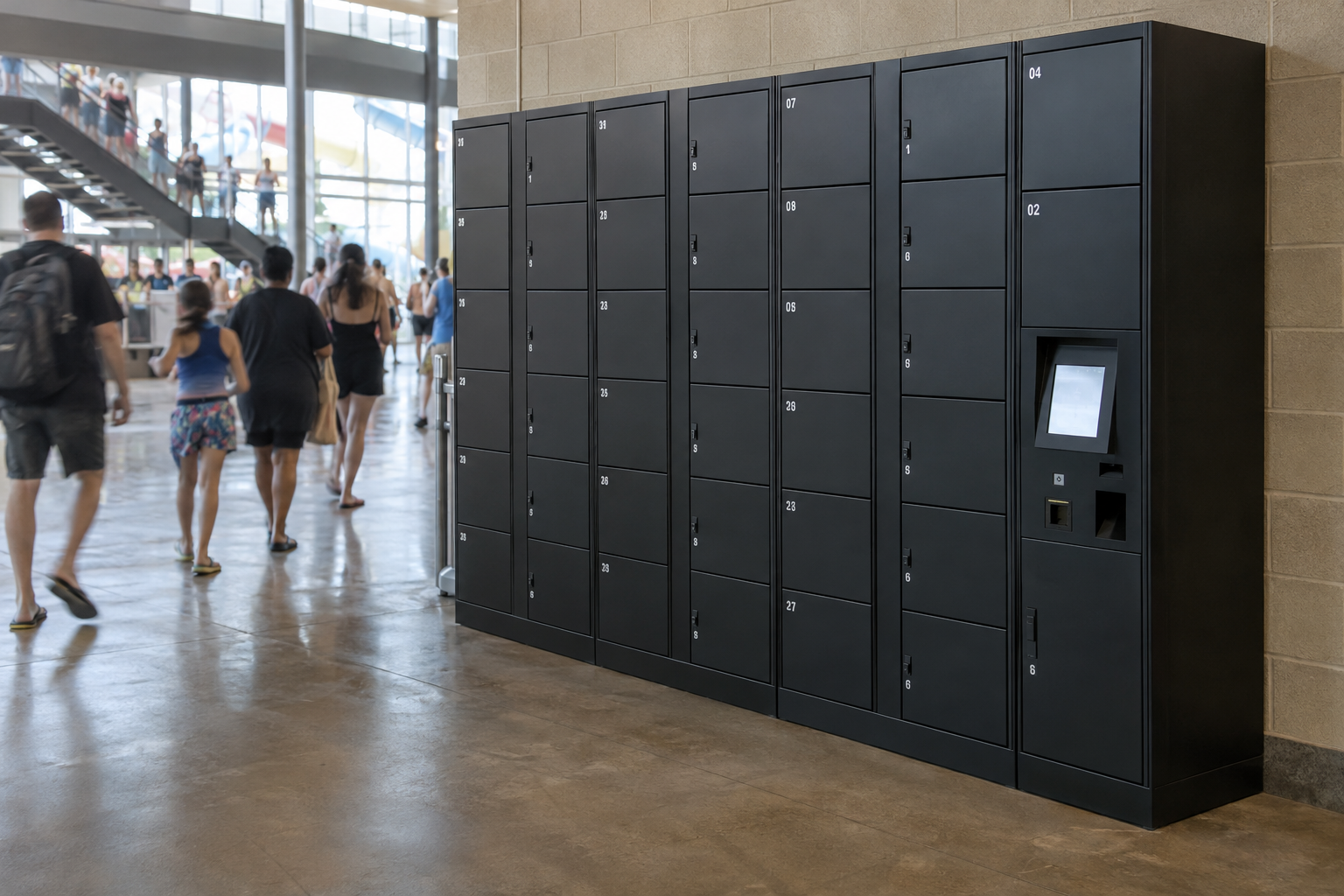
How much do smart lockers cost? For a venue, the honest answer is that there is no catalogue price — the quote is built from tower count, door mix, kiosk hardware, indoor or outdoor rating, payment and software fees, installation and freight. Published per-unit ranges for office and parcel systems sit roughly between $2,500 and $25,000 per unit, but those numbers describe a different product than a guest-facing day-use locker wall at a water park, stadium or airport.
This guide breaks the quote into its real parts, shows you the two ways venues pay for lockers, and gives you a checklist to compare vendors on the same basis.
How much do smart lockers cost? The short answer
Smart locker systems are quoted per project, not per door. Published figures for workplace and parcel lockers run from about $3,000 to $12,000 per unit (ForwardPass) and €6,000 to €25,000+ per unit for courier and retail configurations (Parcel Hive). Venue day-use pricing depends on tower count, kiosk, weather rating, software and install.
Why published smart locker price ranges rarely match a venue quote
Almost every "smart locker price" article you will find online is written for IT departments buying device-charging bays or property managers buying parcel lockers. Those comparisons quote £2,400 to £9,500 per unit (LocknCharge), and for parcel systems $6,000 to $21,000 for the lockers alone before customisation, installation and service contracts (Pitney Bowes).
Those ranges are useful for one thing only: showing you how wide the spread is. A venue locker program differs in three ways that move cost:
- Throughput, not storage. A theme park locker bank may turn over two or three times a day in summer. Hinges, latches and door skins are specified for tens of thousands of cycles a season, not a few hundred.
- Guests, not staff. Unfamiliar users need a kiosk or clear app flow, multilingual prompts, ADA-compliant reach ranges and on-the-spot card payment. That is a different bill of materials from a badge-reader cabinet.
- Environment. Chlorine, salt air, sunscreen, UV and rain change the finish, the seals and the electronics enclosure. Grand View Research notes outdoor deployment is the fastest-growing segment of the smart locker market, at a 12.8% CAGR (Grand View Research).
It is also worth knowing the market context when you benchmark: hardware accounts for roughly 77% of smart locker spend overall, with software and services making up the rest (Grand View Research). If a quote is almost entirely software, or almost entirely steel, ask why.
The seven drivers behind any smart locker price
1. Tower count and door mix
This is the biggest single line. Price scales with the number of towers and, within each tower, the split between small, medium and large doors. Size your bank from peak-hour demand, not daily attendance: count the busiest 60 minutes, assume a realistic rental rate for your guest type, and add headroom so the wall never sells out before your busiest gate opens. Oversizing is expensive; undersizing costs revenue and generates queues.
See the configurations we build on our products page before you set a door count.
2. Locker kiosk cost
A kiosk is a separate line item: screen, payment terminal, enclosure, mounting and the compute behind it. Locker kiosk cost is justified where guests arrive without the app, where phones get left in cars or where language diversity is high — airports, water parks, festivals. App-and-PIN-only deployments remove the kiosk cost but push more friction onto the guest. Many venues run one kiosk per bank, or one kiosk serving two adjacent banks, as a compromise.
3. Indoor versus outdoor rating
Outdoor and wet-area lockers cost more than indoor units: sealed electronics, corrosion-resistant hardware, drainage, UV-stable finishes and sometimes shade or canopy work. Beach and poolside installations — like the beach lockers at Celebration Key — sit at the demanding end of this spec. Indoor lobby or concourse installs, such as an arena locker wall in Montreal or an airport luggage locker wall in Oslo, cost less per door for the same software.
4. Payments
Cashless payment means a payment terminal or an integrated online processor, plus processing fees on every rental. Decide early whether guests pay at the kiosk, in the app, or both, and whether you need to support contactless cards, wallets and local payment methods. Processing fees are a per-transaction operating cost, not a capital cost — model them in your revenue forecast.
5. Software and platform fees
Cloud software, connectivity, remote unlock, reporting and support are recurring. This layer is modest against the hardware but runs for the life of the program, and it is the line most often left out of a budget request (ClickNCollect). Ask whether the fee is per locker, per door, per site or a share of revenue, and what happens to it in year three.
6. Smart locker installation cost
Smart locker installation cost is driven by your site, not by the lockers. Power availability, network or cellular coverage, floor or pad condition, anchoring, ADA clearances, lighting and whether the work must happen overnight or in an off-season window all change the figure. For an indoor site with power and data already at the wall, installation is a small share of the project. For a standalone outdoor site needing a pad and a new power run, site infrastructure can be the single largest component of the whole program (ClickNCollect).
7. Freight, lead time and spares
Locker towers are heavy and bulky. Freight, lift gate or crane access, and site storage before install are real numbers. Build in spare doors, locks and a kiosk screen — a dead door on a peak Saturday is lost revenue and a guest complaint.
Buy versus revenue share: the two ways venues pay
| Buy outright | Revenue share | |
|---|---|---|
| Upfront capital | Full hardware, kiosk, install and freight | Storage Lockers covers the hardware |
| Who owns the lockers | You | Storage Lockers |
| Ongoing cost | Software/platform fee, payment processing, maintenance | Agreed share of rental revenue |
| Revenue upside | You keep all rental income | Shared |
| Best when | Steady year-round demand, available capex, long asset life | Seasonal venues, new programs, no capex, want to test demand |
| Risk profile | You carry demand risk | Risk is shared with the supplier |
Neither model is "cheaper" in the abstract. Buying wins when utilisation is high and predictable, because you keep every rental over a multi-year asset life. Revenue share wins when you have no capex line, when your season is short, or when you want proof of demand before committing. Many operators pilot on revenue share and convert to purchase at renewal once they have a year of real usage data.
An illustrative way to frame the decision
Illustrative, round numbers only. Suppose a bank rents 200 times a day at $10 across a 100-day season — that is $200,000 of gross rental revenue. Under purchase, you subtract capital cost amortised over the asset life, plus software and payment fees. Under revenue share, you subtract the agreed percentage and zero capital. Run both against your own attendance and rental rate; our venue locker ROI breakdown walks through the maths.
One scale note worth borrowing from the parcel world: operators running many locations see materially better per-unit economics, because software and manufacturing costs amortise across sites (Parcel Hive). If you run a portfolio of venues, quote them together, not one at a time.
Checklist: what to ask before you accept any locker quote
- Is the price per door, per tower or per project — and what exactly is included?
- Is the kiosk a separate line, and is one kiosk enough for this bank?
- What is the ingress/corrosion rating, and is it warranted for my environment?
- Who pays for payment processing, SIM/connectivity and software, and for how long?
- What is the installation scope, and what site work is excluded (power, pad, data, anchoring)?
- What is freight, and who handles offload and site access?
- What are the lead times, and can install happen in my off-season window?
- What is the warranty, the spares policy and the on-site response time?
- Under revenue share, what is the split, the term, and who owns the hardware at the end?
- Can I see usage reporting before I commit, and can I change pricing per day or per event?
Any supplier willing to quote a firm figure before discussing your site is quoting a number they cannot stand behind (ClickNCollect).
Frequently asked questions
How much do smart lockers cost per door?
There is no reliable per-door figure across venues, because door cost changes with size, weather rating and lock type, and because kiosk, install and freight are shared across the whole bank. The useful comparison is total installed cost per door for your specific configuration — ask every vendor to present it that way so quotes are comparable.
Is smart locker installation cost included in the quote?
Sometimes, but often only partially. Many quotes cover delivery and mounting but exclude site work such as power runs, concrete pads, data drops and anchoring. Ask for the installation scope in writing, with exclusions listed, before you compare prices.
Do smart lockers have ongoing monthly fees?
Yes. Expect recurring software, connectivity, support and payment-processing costs for the life of the program. These are small relative to hardware but continuous, and they belong in your budget from day one rather than appearing in year two.
Can a venue get smart lockers with no upfront cost?
Yes — that is what a revenue-share program is for. Storage Lockers covers the hardware and you share rental revenue, which removes the capital request and shifts demand risk off your budget. It suits seasonal venues and first-time locker programs especially well.
Are outdoor lockers more expensive than indoor ones?
Yes. Sealed electronics, corrosion-resistant hardware, drainage and UV-stable finishes all add cost, and outdoor sites usually need more site work. Outdoor is also the fastest-growing deployment segment in the smart locker market, so the specification options have widened considerably.
Next steps
Send us your venue type, peak-hour attendance and whether the location is indoor, outdoor or wet-area, and we will size the bank and price it both ways — purchase and revenue share. Get a quote or book a call to walk through your site with our team.
Sources
- How Much Do Smart Food Lockers Cost? A Buyer's Guide
- Smart Locker Pricing 2026: Save 40% with Custom Config - Parcel Hive
- Smart Parcel Locker Market Size | Industry Report, 2033
- How Much Does a Smart Locker Cost? - ForwardPass
- How Much Does a Smart Locker Cost? | LocknCharge EU
- Smart (Electronic) Parcel lockers: How much will it cost your organization?
Planning lockers for your venue?
Tell us about your site and we'll recommend a configuration and commercial model.