
Coin Operated Lockers vs Smart Lockers: Operator Guide
By Storage Lockers team · Published October 23, 2026
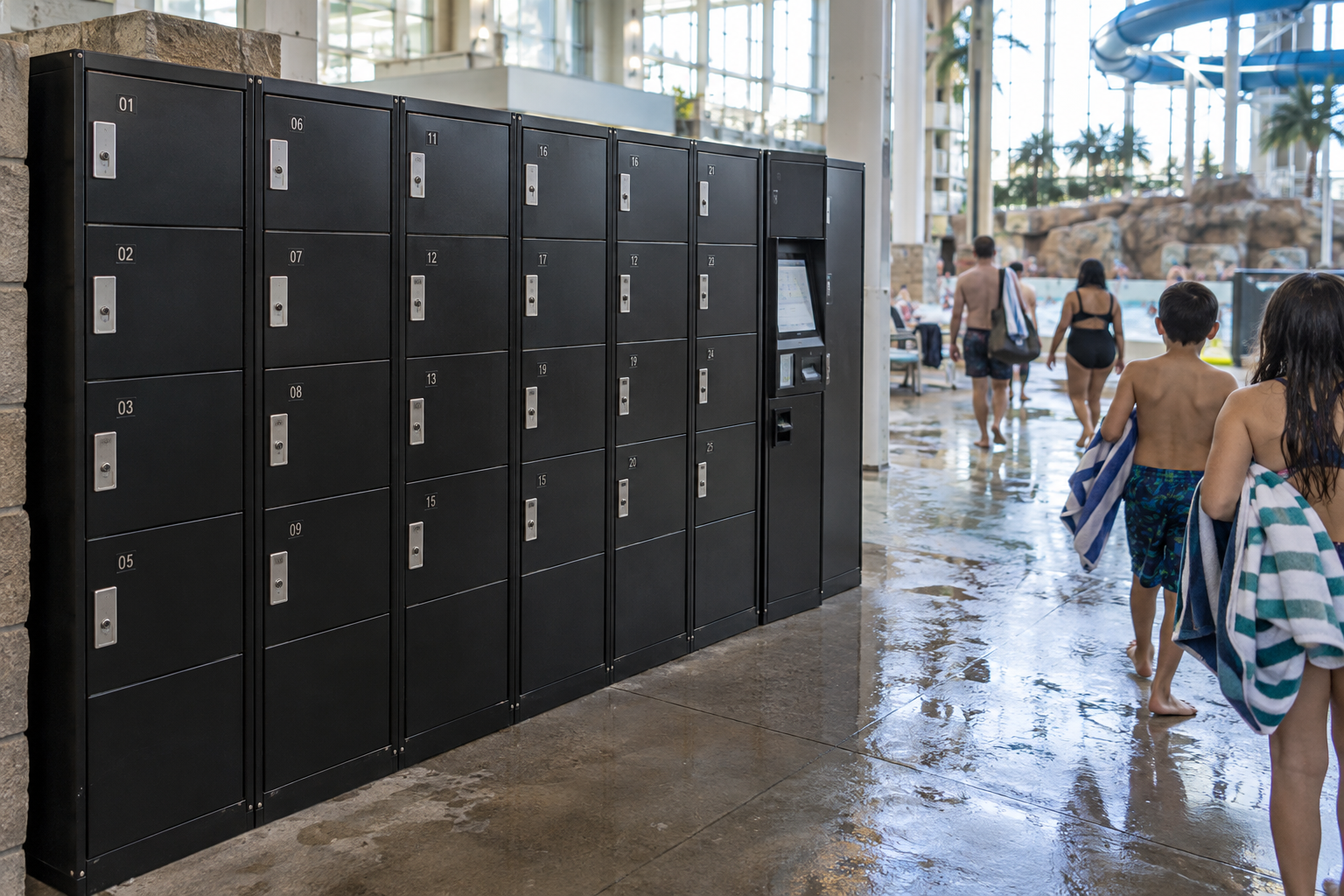
For most high-traffic venues, the coin operated lockers vs smart lockers decision comes down to four line items: cash handling, lost keys, staff hours and lost revenue you can't see. Coin lockers are cheap to buy and simple to run until volume rises; smart lockers cost more upfront but remove cash from the floor, eliminate keys, and give you per-locker revenue and occupancy data. Coin lockers still make sense in low-volume, low-connectivity, low-value-storage settings.
Coin operated lockers vs smart lockers: the short answer
Coin operated lockers charge a fixed fee via a mechanical coin slot and hand the guest a key. Smart lockers use electronic locks opened by PIN, QR code, app or card, with cashless payment and a cloud dashboard. Smart lockers remove cash collection, key replacement and most staff intervention — at a higher upfront hardware cost.
Side-by-side comparison
| Factor | Coin operated lockers | Smart lockers |
|---|---|---|
| Access method | Coin or token, physical key | PIN, QR, app or card credential (Gantner) |
| Payment | Cash/coins only, fixed denomination | Card, mobile wallet, app, prepaid; cashless |
| Cash handling | Daily collection, counting, banking, reconciliation | None at the locker bank |
| Keys | Lost, stolen or duplicated keys are routine (Vpod) | Keyless; access revoked or reissued remotely |
| Staff involvement | Frequent intervention: refunds, lockouts, jams | Exception handling only |
| Typical failure modes | Coin jams, broken mechanical locks, bent doors | Lock/controller faults, connectivity drops, payment errors |
| Pricing flexibility | Fixed per coin denomination | Tiered, time-based, size-based, promo codes |
| Reporting | None, or manual cash counts | Per-locker occupancy, revenue, audit trail |
| Audit trail | None — disputes are he-said-she-said | Every open/close timestamped (eLocker) |
| Upfront cost | Low | Higher; can be shifted to a revenue-share model |
| Remote management | None | Open doors, refund, reprice from a dashboard |
Cash handling: the cost nobody budgets for
Coin lockers only look free to run. Someone has to open the coin boxes, count, bag, reconcile and bank the takings — and do it under dual control if your finance team is doing its job. Then there's the change problem: if your locker takes a specific coin or token, you need a change machine, a token stock, or a guest services desk fielding "do you have change?" all day.
Cash also leaks. Untracked coin revenue is the single hardest thing to audit in a venue, because there is no transaction record to compare against the box total (Vpod). With smart lockers, every rental is a card or app transaction that settles to a statement you can reconcile line by line.
Worked example (illustrative, round numbers): 200 lockers, 60% daily utilisation, $10 per rental, 200 operating days = $240,000 in annual locker revenue. If coin collection and reconciliation takes 45 minutes a day at a $25 fully loaded hourly rate, that's roughly $3,750 a year in labour before a single jam is cleared. Model your own numbers with the venue locker ROI breakdown.
Lost keys: the quiet operational tax
Every coin locker key is a liability. Guests take them into water, lose them in sand, pocket them on the way out, or hand them to a friend. Each lost key means a staff member with a master key, an incident log, a replacement key cut, and eventually a lock change. In a water park or beach setting, key loss is near-constant — it's the reason our beach lockers at Celebration Key and the airport luggage locker wall in Oslo are PIN and app based rather than key based.
Smart lockers remove the physical token entirely. A forgotten PIN is resolved by re-sending a code, not by hunting for a master key. Lost-and-found and abandoned-contents workflows also get easier, because the system tells you exactly which doors are still occupied past closing and when they were last opened.
Staff time and uptime
Ask your guest services lead what they actually do during peak hour. At coin-locker venues, the answer is usually: open stuck doors, clear coin jams, make change, and adjudicate disputes about whether a locker was paid for. Those are all manual tasks with no audit trail behind them (Vpod).
Smart lockers don't eliminate faults — they change the failure mode. Instead of a mechanical jam that stays broken until someone walks past, you get a dashboard alert, and most issues (a stuck door, a mis-charged guest, a guest who left before retrieving a bag) can be resolved remotely. That matters at scale: a 400-door wall with three faults you can see beats a 100-door bank with one fault you don't.
The trade-off is that smart lockers depend on connectivity and power. Before you commit, ask any vendor how the system behaves offline — can locks still open on a cached PIN? Is there cellular failover alongside Wi-Fi? Connectivity type (BLE, cellular, Wi-Fi) is a core spec in the category, not an afterthought (360iResearch).
Payment options, pricing control and reporting
A coin lock has exactly one price: whatever the mechanism accepts. You cannot run a $12 peak-season rate and a $7 shoulder-season rate, you cannot upsell a large size, and you cannot sell an all-day re-entry pass.
Smart systems let you set pricing by locker size, time of day, duration or event — and change it from a dashboard without touching hardware. That pricing control is usually where the revenue case is won, not in the per-rental fee itself. See amusement park locker rental pricing for how operators structure tiers.
Reporting is the other structural difference. A smart locker system adds identity, control, traceability and data on top of plain storage (eLocker), so you can see utilisation by bank, by size and by hour. That tells you whether to add doors, change the size mix, or move a tower closer to the entrance — the same data you need when sizing a water park locker programme.
Guest experience and throughput
The guest-facing difference is friction. Coin lockers require the right coin, a key you must carry while swimming or riding, and a trip back to guest services if anything goes wrong. Keyless access via PIN, app or card removes all three steps and lets guests reopen a locker as many times as they like during the day (Gantner).
Throughput matters at opening rush. One kiosk serving a 200-door wall will bottleneck; app-based rentals and multiple kiosks won't. When we specify an arena locker wall like the one in Montreal, the kiosk-to-door ratio is sized against the 20-minute pre-event surge, not the daily average.
When keeping coin operated lockers still makes sense
Smart isn't automatically right. Keep or specify coin lockers when:
- Volume is genuinely low. A 20-door bank at a municipal pool with 10 rentals a day won't repay a connected system.
- There's no power or connectivity and running either is cost-prohibitive — a remote trailhead or beach hut, for example.
- Your guests are cash-first. Some markets and demographics still are; a cashless-only wall shuts them out unless you add a prepaid card option.
- The lockers are free-to-use with a refundable coin. If you're not monetising, the business case rests only on labour savings.
- You have capital constraints and no appetite for a revenue-share agreement.
Even then, note the market direction: the broader locker market is forecast to grow from about $3.22 billion in 2025 to $10.76 billion by 2035 at a 12.82% CAGR, with electronic lockers the fastest-growing product segment (Market Research Future). Demand for contactless, connected self-service is the driver behind smart locker growth generally (MarketsandMarkets).
How to replace coin lockers without replacing the furniture
You don't always need new cabinets. If your existing locker bodies are structurally sound, battery-powered electronic locks can often be retrofitted into the drill patterns already used by coin or card locks, with no cabling required and battery life measured in years (Gantner). That makes a phased switch realistic: retrofit the highest-traffic bank first, run it alongside coin lockers for a season, and compare revenue per door.
If the cabinets are corroded, undersized for modern bags, or the wrong size mix, buy new. Review door sizes and configurations on our products page before you decide.
Checklist: evaluating the switch
- Count your real coin revenue per door per operating day — not the budget figure.
- Log staff minutes spent on keys, jams, refunds and change for two peak weeks.
- Count lost keys and lock replacements over the last 12 months.
- Confirm power and network availability at each locker location.
- Decide your payment mix: card, wallet, app, and a cash-to-card fallback if needed.
- Ask vendors: offline behaviour, SLA and response time, who owns payment processing, refund workflow, data export, and door-size mix.
- Choose a funding route — capital purchase or locker revenue share, where the hardware cost is covered and you share the income.
For budget ranges, see how much smart lockers cost, and compare ownership models in locker revenue share vs. buying.
Frequently asked questions
Are smart lockers more expensive than coin operated lockers?
Per door, yes — smart lockers include an electronic lock, controller, kiosk and software, so the upfront cost is higher than a mechanical coin lock. The comparison that matters is total cost over five years, including cash handling, key replacement, lock repairs and the revenue you can't capture with fixed coin pricing. A revenue-share agreement can remove the upfront cost entirely.
Can I replace coin lockers without buying new cabinets?
Often yes. Battery-powered electronic locks are designed to fit the existing drill patterns used by coin and card locks and need no cabling, which makes retrofitting a practical option when the locker bodies are still sound. If your door sizes no longer match guest needs — oversized bags, strollers, helmets — new cabinets usually make more sense.
What happens to smart lockers if the internet goes down?
Well-designed systems keep working locally: locks hold cached credentials so issued PINs still open doors, and transactions sync when the connection returns. Ask any vendor to demonstrate offline mode and to confirm whether the system has cellular failover in addition to Wi-Fi.
Do electronic lockers still accept cash?
Most smart locker deployments are cashless by default, using card, mobile wallet or app payment. If a share of your guests pay in cash, the usual workaround is a cash-to-prepaid-card machine or letting guest services sell a locker code at the till, rather than putting coin mechanisms back on the wall.
How do I prove the business case to my finance team?
Build it from three numbers: current coin revenue per door, annual labour and maintenance spend on keys, jams and collections, and the uplift from flexible pricing and higher utilisation. Run those through the venue locker ROI breakdown and present a single payback period.
Next steps
Tell us your door count, venue type and peak-hour pattern, and we'll size the system and model both purchase and revenue-share options. Get a quote or book a call to walk through your existing coin locker numbers with our team.
Sources
- Smart Locker Market Size, Share, Trends and Growth Analysis 2033
- Leisure Lockers Vs Coin Lockers - Vpod Smart Solutions
- Locker Market Size, Share Report and Industry Trends 2035
- Smart Locker - 360iResearch
- Coin Lockers vs Smart Lockers | Reduce Maintenance
- Smart locker systems for every industry - Gantner
- What is a smart locker? - eLocker
Planning lockers for your venue?
Tell us about your site and we'll recommend a configuration and commercial model.